
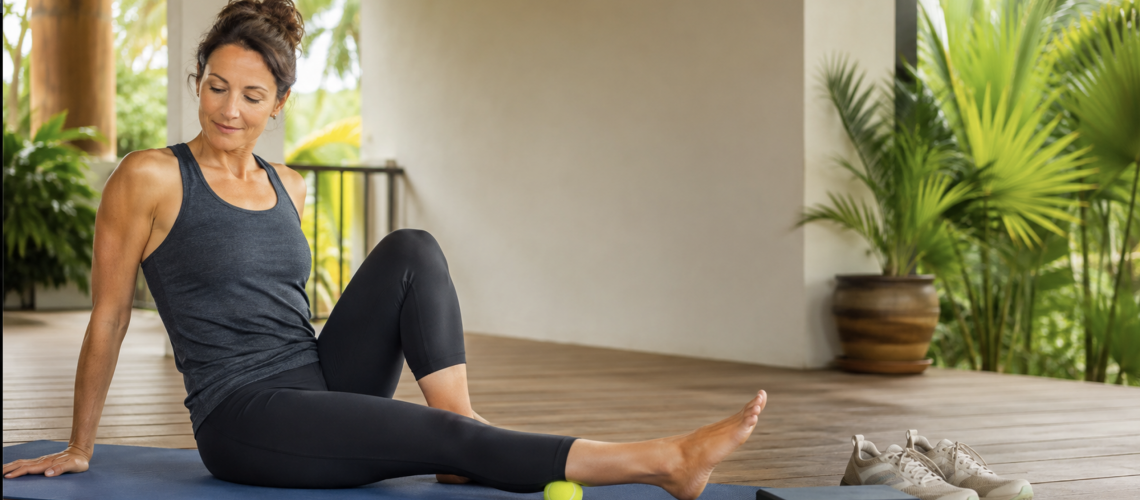
The Warm-Up Before the Warm-Up: Ball Acupressure First, Movement Second
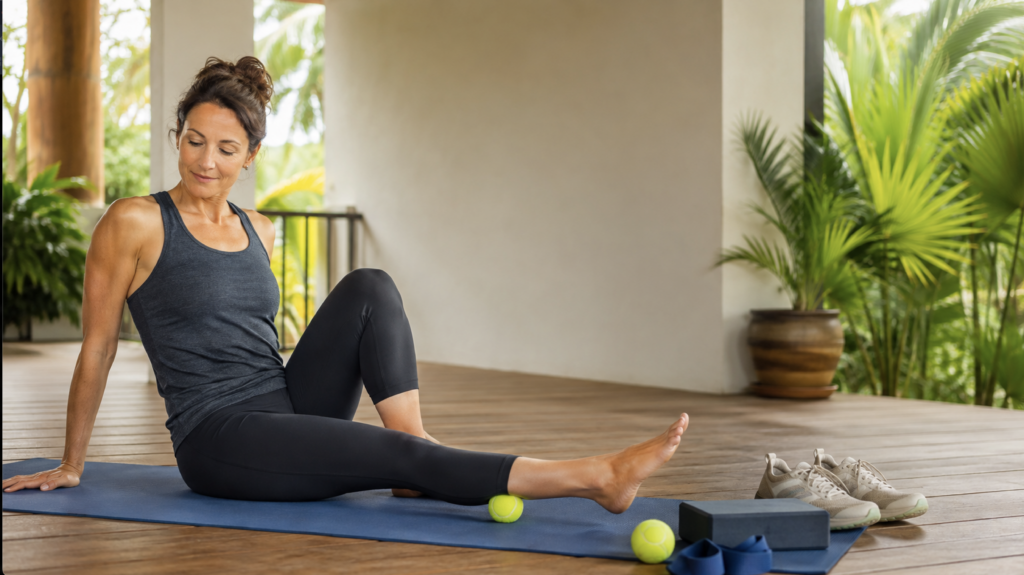
A Ball Acupressure warm-up can prepare tight, stiff muscles before you stretch, exercise, practice yoga, or begin a sport. Instead of immediately demanding movement from a restricted muscle, apply pressure first, follow with gentle movement, and then gradually begin your activity.
A Simple Five-Minute Ball Acupressure Warm-Up
A Ball Acupressure warm-up gives you a way to prepare the areas that feel tight before asking them to move
Most people understand that warming up before physical activity is important. However, many people begin their warm-up by immediately stretching, exercising, or moving a stiff and resistant area.
They may bend forward to stretch their hamstrings, enter a difficult yoga position, begin their physical therapy exercises, swing a golf club, lift a weight, or start working in the garden—all before preparing the muscles involved.
But what if the muscles are not ready to move yet?
Before asking a muscle to stretch, strengthen, stabilize, or perform, it makes sense to prepare that muscle first.
That is where Ball Acupressure can become the warm-up before the warm-up.
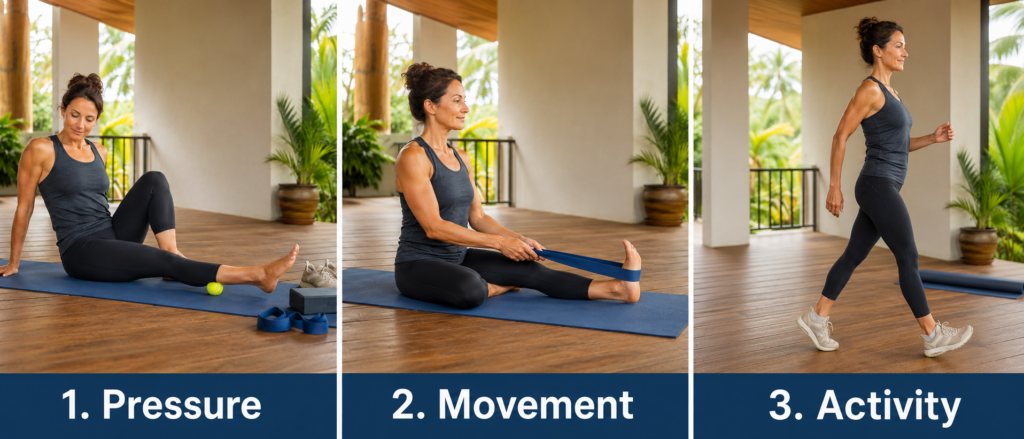
The sequence is simple:
Ball Acupressure first. Gentle movement second. Activity third.
Ball Acupressure does not have to replace stretching, yoga, exercise, physical therapy, chiropractic care, or any other form of movement. Instead, it can help prepare the muscles so those activities may feel more comfortable and productive.
What Does It Mean to Warm Up a Muscle?
A warm-up should gradually prepare your body for what you are about to do.
This does not mean that you have to become sweaty or exhausted. It means giving your muscles, joints, nervous system, and connective tissues time to adjust before placing greater demands on them.
When people feel stiff, they often respond by stretching harder. But stiffness is not always solved by forcing a muscle into a longer position.
Sometimes the body is guarding an area. Sometimes a muscle is tender, overworked, or reluctant to move. Trying to force that area may cause the body to resist even more.
Conventional warm-ups generally begin with an activity at a slower pace and lower intensity before progressing gradually.
Ball Acupressure offers another approach.
By applying controlled, sustained pressure to selected areas, you give the body an opportunity to relax and adapt before asking it to move. Many people notice that an area feels less restricted and that movement becomes easier afterward.
Research involving related self-myofascial release methods, including foam rolling, suggests that brief applications may improve short-term range of motion without necessarily reducing strength or muscle performance. Research also supports combining this type of preparation with an active or dynamic warm-up rather than treating it as the entire warm-up.
Ball Acupressure uses a more targeted approach than general foam rolling. Instead of repeatedly rolling over a large area, you position the ball on a carefully selected location and allow steady pressure to do the work.
Step One: Ball Acupressure
Begin by identifying the muscles that will be used during your activity.
For example:
- Before walking or hiking, prepare the calves, hips, gluteal muscles, and hamstrings.
- Before golf or tennis, prepare the hips, upper back, shoulders, and legs.
- Before gardening, prepare the low back muscles, hips, hamstrings, and shoulders.
- Before yoga, prepare the areas that feel most restricted in the positions you plan to practice.
- Before physical therapy exercises, prepare the muscles involved in those exercises, provided your therapist agrees that pressure is appropriate.
- Before strengthening exercises, prepare the muscles you will be training that day.
- https://acupressureworks.com/product/acupressure-works-ebook/
Place a tennis ball or another appropriate ball against the selected area. Use the floor, a wall, a chair, or your hand to control the amount of pressure.
Ball Acupressure should feel strong enough to be useful but not so intense that you hold your breath, tighten the rest of your body, or struggle against it.
Once the ball is in the correct position:
- Allow your body weight to settle gradually.
- Use steady pressure rather than rapid or aggressive rolling.
- Breathe normally.
- Stay on the area long enough to notice whether the sensation begins to change.
- Reduce the pressure if the area becomes sharper, more painful, numb, or increasingly irritated.
The purpose is not to punish the muscle.
The purpose is to prepare it.
Step Two: Add Gentle Movement
After using Ball Acupressure, move the same area through a comfortable range of motion.
This step is important because pressure prepares the area, but movement teaches your body how to use the newly available range.
The movement should resemble the activity you are preparing to perform, but it should begin slowly and easily.
Examples include:
- Gentle leg swings before walking, running, or kicking
- Shoulder circles before swimming, tennis, or upper-body exercise
- Slow hip rotations before golf or yoga
- Easy spinal movement before gardening or lifting
- Unresisted repetitions of a physical therapy exercise
- A shallow squat before progressing to a deeper squat
- Several easy practice swings before a full golf or tennis swing
Dynamic movement has been shown to be a useful component of many warm-up programs, especially when the movement prepares the body for the activity that follows. The amount should be appropriate, because excessive warm-up activity can also create fatigue.
Think of this second step as a conversation with your body.
You are not demanding full performance yet. You are showing the muscles and joints what they will soon be asked to do.
Step Three: Gradually Begin Your Activity
Once you have applied pressure and introduced gentle movement, begin the main activity gradually.
Do not move directly from sitting still to maximum effort.
A complete progression might look like this:
Pressure → easy movement → moderate movement → normal activity
For a person preparing to walk, this could mean using Ball Acupressure on the calves and hips, performing ankle and hip movements, and then walking slowly for several minutes before increasing speed.
For a golfer, it could mean preparing the hips, shoulders, and upper back, followed by gentle rotations and several easy practice swings.
For a person beginning physical therapy exercises, it might mean preparing a tight muscle, performing the exercise without resistance, and then gradually adding the resistance prescribed by the therapist.
For yoga, it could mean using Ball Acupressure on a restricted area, moving through a comfortable range, and then entering the first poses gradually rather than immediately forcing the deepest position.
Before Stretching
Try a Ball Acupressure warm-up before beginning your usual stretching routine.Stretching is not necessarily the enemy.
The problem is often the order in which stretching is performed.
When a person feels stiff, the natural reaction is to pull harder on the muscle. But forcing a cold, guarded, or sensitive area may not produce the response you want.
Try Ball Acupressure first.https://acupressureworks.com/2026/02/07/fascia-ball-acupressure/
The stretch may feel more comfortable. Your range may increase. The muscle may resist less. You may also discover that you do not need to force the stretch as aggressively.
Static stretching can still have a place in a flexibility program. However, it should not always be treated as a complete warm-up by itself, particularly before activities that require speed, power, coordination, or rapid movement.
Before Yoga
Yoga requires flexibility, strength, coordination, balance, and control.
Even though yoga is sometimes viewed as a warm-up, many poses place substantial demands on the muscles and joints. A person with tight hamstrings, restricted hips, a stiff upper back, or limited shoulder movement may benefit from preparing those areas before attempting deeper positions.
Ball Acupressure can be used before yoga to focus on the areas that commonly limit your practice.
After applying pressure, move gently through the intended range. Then enter the yoga pose slowly and stop before pain or excessive strain.
The goal is not to force yourself farther into a pose. The goal is to help your body approach the pose with less resistance.
Before Physical Therapy
Physical therapy exercises are designed to improve movement, strength, stability, balance, and function.
However, people sometimes begin their exercises while the surrounding muscles are still tight or guarded.
When appropriate, Ball Acupressure may be used as a preparation step before performing the exercises prescribed by your therapist. For example, you might prepare a tight calf before ankle exercises or prepare the hip muscles before performing strengthening and balance work.
Ball Acupressure should not replace your therapist’s evaluation or treatment plan. Ask your therapist which areas are appropriate to work on, how much pressure to use, and whether there are areas you should avoid.
Before Chiropractic Treatment or Exercises
Ball Acupressure should not be promoted as a substitute for chiropractic evaluation or treatment.
However, it may be useful before mobility exercises or corrective movements recommended by a chiropractor. It may also be useful between appointments when your practitioner agrees that it is appropriate.
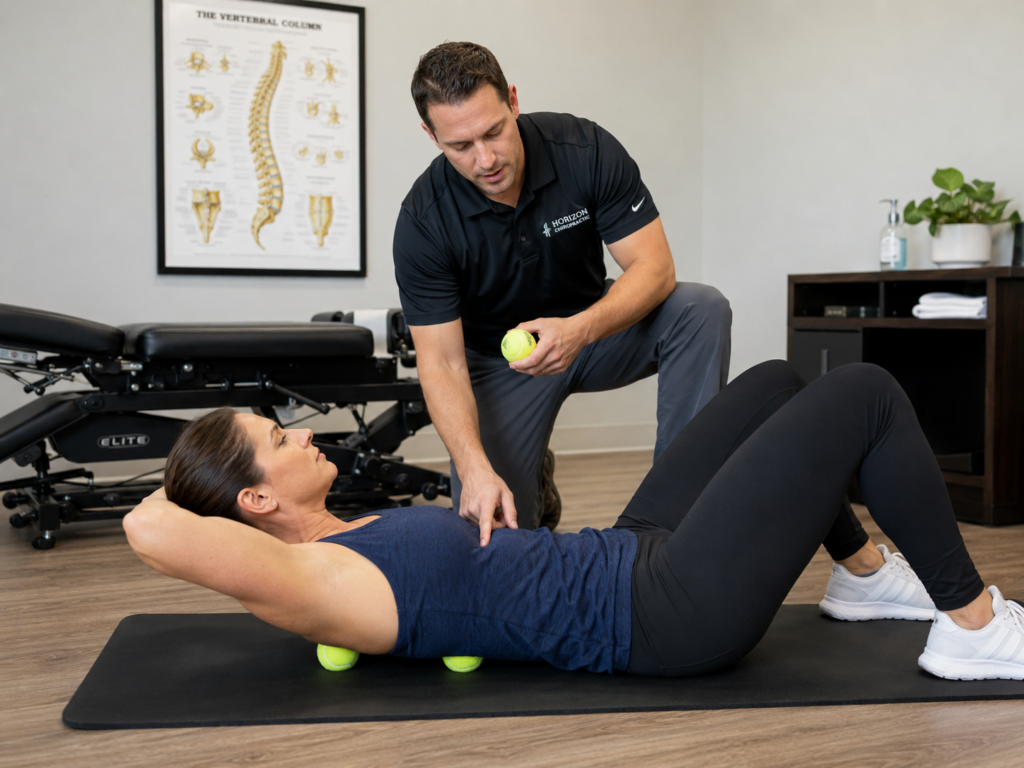
Avoid applying strong pressure directly over the spine. The ball should generally be positioned against the surrounding muscles rather than on the bones of the spinal column.
If you are receiving treatment for a specific spinal condition, discuss Ball Acupressure with your healthcare provider before adding it to your routine.
Before Sports and Exercise
Athletes often spend a great deal of time working on strength, speed, technique, and endurance but very little time preparing the specific muscles that feel restricted. A Ball Acupressure warm-up can focus specifically on the muscles you are about to use.
A runner may begin running with tight calves.
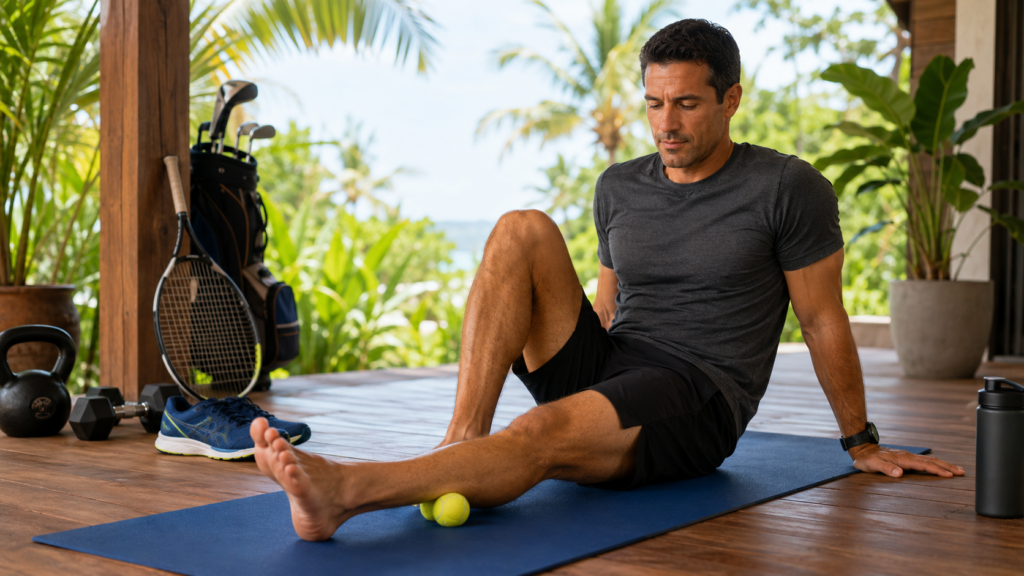
A tennis player may begin serving with a stiff shoulder.
A golfer may start rotating through a restricted hip.
A weightlifter may begin loading a muscle that has barely moved all day.
Ball Acupressure gives you a way to focus on the muscles that need attention before you place greater demands on them.
It is not necessary to treat every muscle in the body. Concentrate on the muscles that will be used most and the areas that commonly feel tight or restricted.
Then follow with movements that resemble your activity.
Before Everyday Activities
You do not have to be an athlete to benefit from warming up.
Everyday activities also place demands on the body:
- Getting out of bed in the morning
- Working in the garden
- Cleaning the house
- Climbing stairs
- Carrying groceries
- Sitting at a computer
- Taking a long walk
- Playing with your children or grandchildren
- Returning to activity after a long car ride
The body does not distinguish between exercise and physical work. Muscles still have to contract, lengthen, stabilize, and coordinate movement.
A few minutes of preparation may make an ordinary activity feel easier.
Test the Difference Yourself
One of the best ways to understand Ball Acupressure is to perform a simple before-and-after test.
Choose one movement that is easy to repeat safely, such as:
- A comfortable forward bend
- The Sit-and-Reach test
- Raising an arm overhead
- Turning your head from side to side
- A shallow squat
- An ankle-flexibility movement
- Rotating your upper body
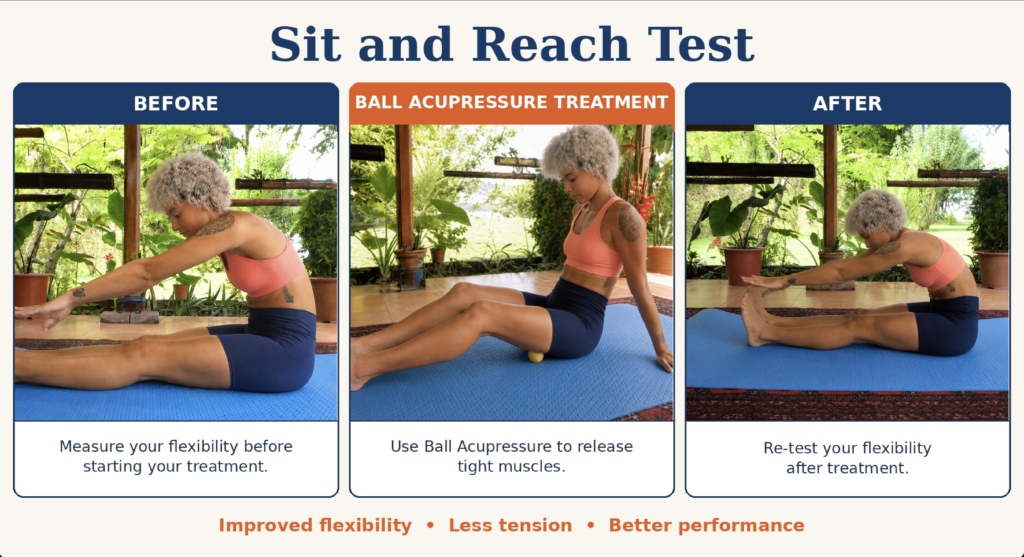
Perform the movement before using Ball Acupressure. Do not force it. Simply observe how far you move and how the movement feels.
Next, apply Ball Acupressure to the appropriate muscle or acupressure point.
Follow it with a few gentle movements.
Then repeat your original test.
Ask yourself:
- Did the movement become easier?
- Did the range change?
- Did the muscle feel less resistant?
- Did I need less effort?
- Did the two sides of my body feel more balanced?
Not everyone will experience the same result, and Ball Acupressure is not appropriate for every condition. But the before-and-after test gives you immediate personal information.
Do not take my word for it.
Test your own movement.
A Simple Five-Minute Routine
You can use this basic sequence before many activities:
Minute 1–3: Ball Acupressure
Choose two or three important areas. Apply controlled, sustained pressure to each area.
Minute 3–4: Gentle Movement
Move the treated muscles through a comfortable range.
Minute 4–5: Practice the Activity
Perform an easy version of the activity you are about to do.
After five minutes, begin gradually and pay attention to how your body responds.
Some people may need more time. Others may only need to prepare one or two specific areas. The routine should match your body and the activity you are about to perform.
Important Safety Guidelines
Ball Acupressure should create a tolerable pressure sensation. It should not create sharp, electrical, burning, or escalating pain.
Do not apply strong pressure:
- Directly over the spine or a joint
- Over an open wound, infection, or active skin problem
- Over a suspected fracture
- Over a recent surgical area unless medically cleared
- Over unexplained swelling
- Over an acute injury without professional guidance
- In an area with significant numbness or reduced sensation
- Where pressure increases tingling, weakness, or radiating pain
Stop if symptoms become worse.
People with serious medical conditions, circulation problems, fragile bones, neurological symptoms, recent surgery, or injuries that have not been evaluated should consult a qualified healthcare professional before using Ball Acupressure.
Ball Acupressure Is the Beginning, Not the Entire Warm-Up
Ball Acupressure does not have to compete with stretching, yoga, exercise, physical therapy, chiropractic care, or sports training.
It can come before them.
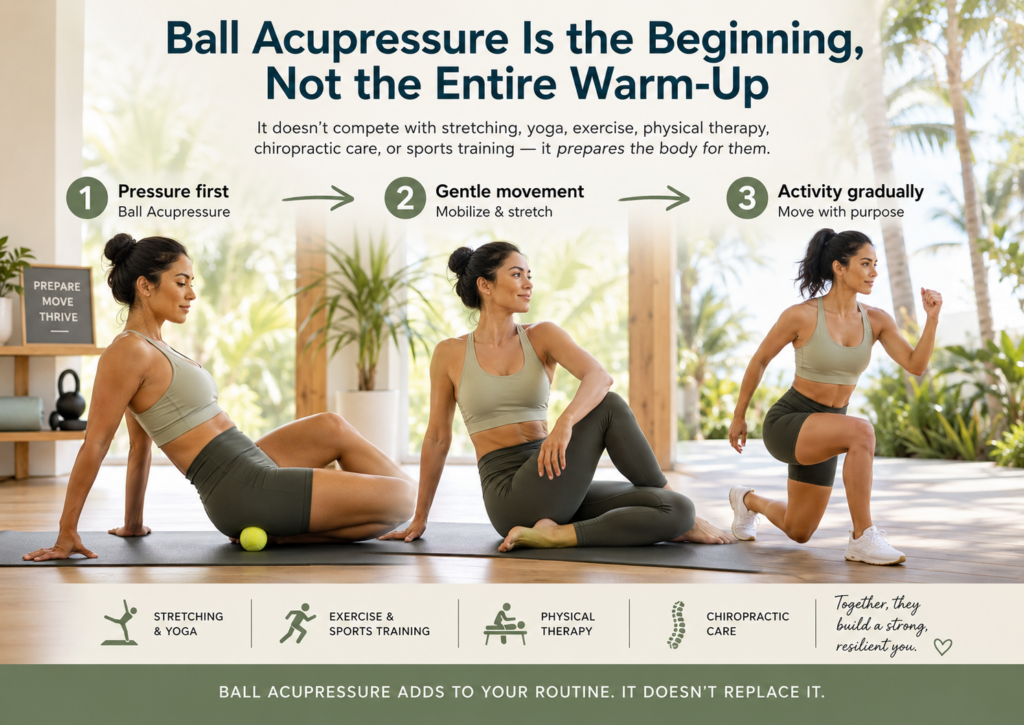
It prepares the area. Movement follows. The activity comes next.
That is the difference between immediately demanding movement from a stiff muscle and gradually preparing that muscle to participate.
The next time you exercise, stretch, practice yoga, perform your therapy exercises, play a sport, or begin a physically demanding task, try changing the order:
First, apply Ball Acupressure.
Second, add gentle movement.
Third, begin your activity gradually.
Pressure first.
Movement second.
Then let your body perform.