
For decades, acupressure has been described in terms of “qi” and energy flow.
But modern fascia research and the work of biophysicist James L. Oschman, PhD provide a different lens.
What if the effects of ball acupressure are not mystical — but electrical?
Let’s explore how fascia ball acupressure may work through bioelectrical signaling, connective tissue science, and what Oschman calls the living matrix.
The Living Matrix: Fascia as a Communication Network
James Oschman’s work in Energy Medicine: The Scientific Basis describes the body as a continuous, electrically responsive connective tissue system.
He calls this system the living matrix.
This matrix includes:
• Fascia
• Collagen fibers
• Extracellular ground substance
• Cellular membranes
Rather than viewing fascia as passive wrapping tissue, Oschman describes it as:
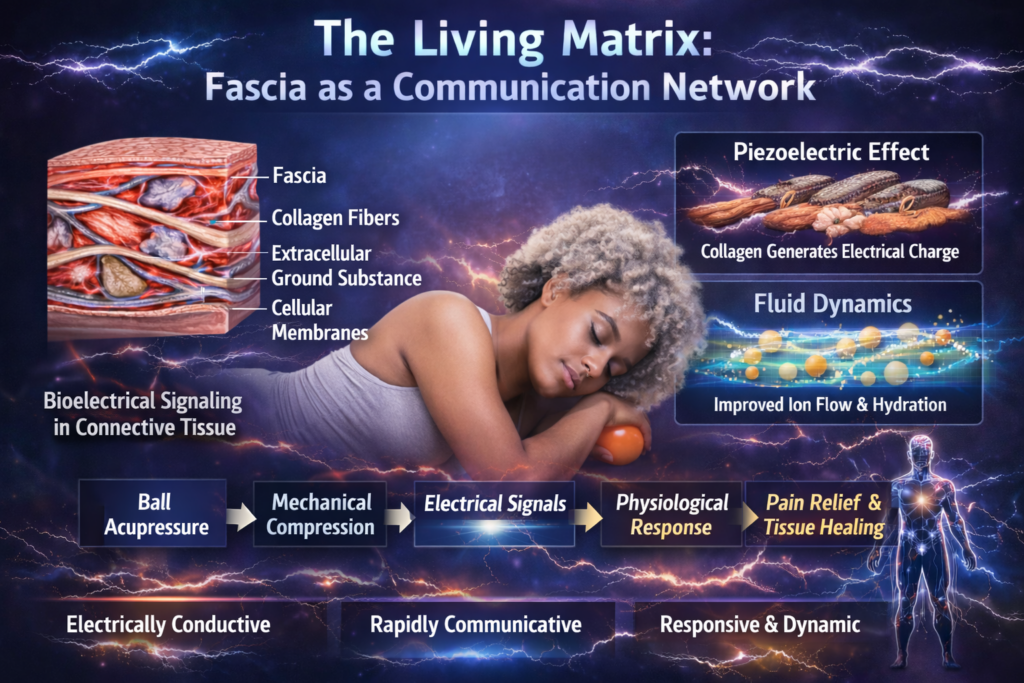
• Mechanically responsive
• Electrically conductive
• Rapidly communicative
Fascia is not just structural — it is informational.
Why Mechanical Pressure Changes Tissue Behavior
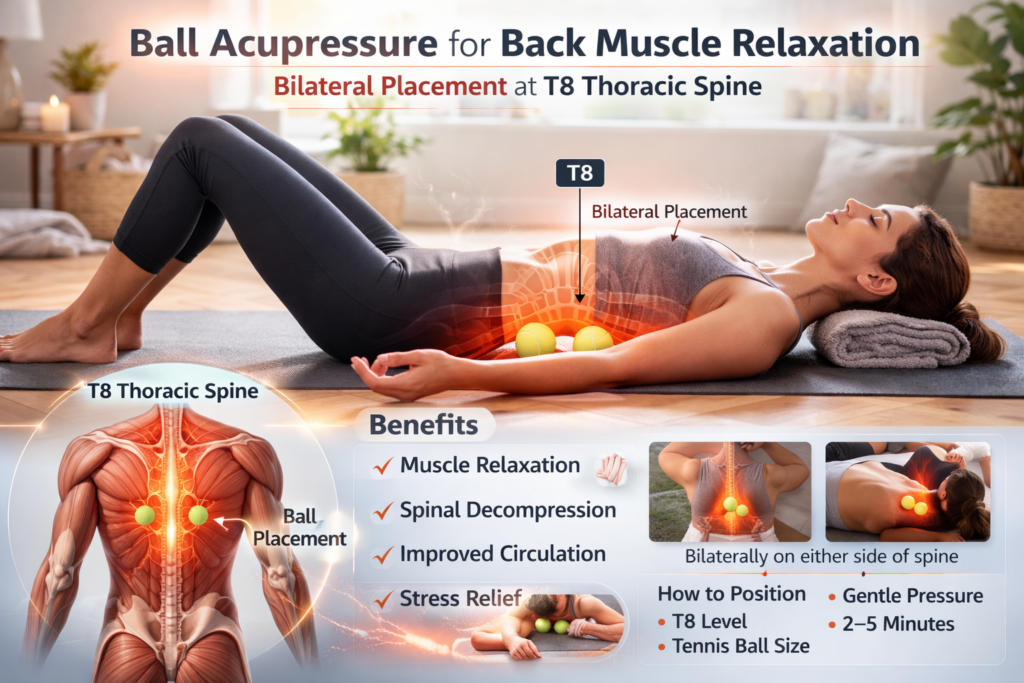
Ball acupressure applies sustained mechanical compression to specific points along fascial pathways.
According to Oschman’s model:
Mechanical stimulation → Electrical change → Physiological response
Here’s how that may work:
1️⃣ Piezoelectric Properties of Collagen
Collagen (a primary component of fascia) is piezoelectric.
When compressed or deformed, it generates small electrical potentials.
Ball pressure may therefore:
• Alter local charge distribution
• Influence fibroblast activity
• Improve tissue hydration
• Modulate inflammatory signaling
This may explain why tissues feel warmer and more pliable after acupressure work.
2️⃣ Electrical Availability of Fascia
Fascia is highly hydrated and contains charged molecules.
Sustained pressure:
• Squeezes interstitial fluid
• Changes ionic gradients
• Alters electrical conductivity
• Improves fluid exchange
This aligns with what we observe clinically:
• Increased warmth
• Improved mobility
• Reduced stiffness
• Faster recovery
Acupoints and Fascial Planes
Oschman suggests that traditional meridians may correspond to:
• Intermuscular
• Myofascial chains
• Neurovascular bundles
• Low-resistance connective pathways
Ball acupressure often follows:
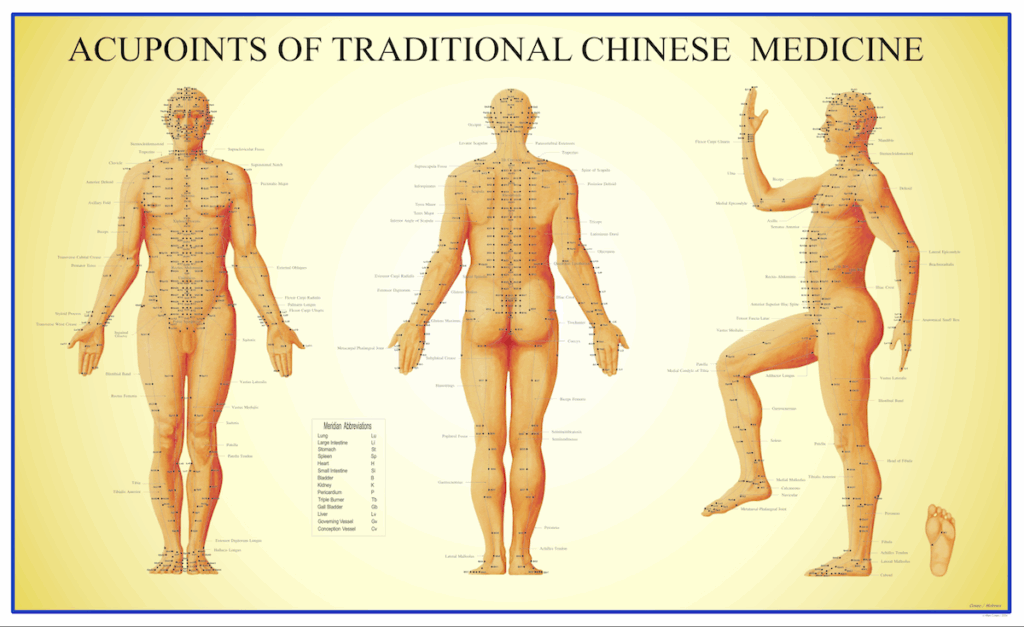
• Bladder meridian lines
• Gallbladder pathways
• Shoulder girdle fascial spirals
• Hamstring–sciatic continuities
These are not isolated points.
They are part of a continuous fascial network.
The Acupressure Warmup: Why Tissue Warms So Quickly
One of the most noticeable effects of ball acupressure is tissue warming.
From a fascia-electrical perspective:
Mechanical compression → Bioelectrical shift → Microcirculation increase → Tissue warmth
The Acupressure Warmup method leverages:
• Slow sustained load
• Parasympathetic activation
• Ruffini receptor stimulation
• Fascial hydration shifts
Unlike aggressive stretching, this method reduces guarding and improves tissue responsiveness.
Warm tissue is responsive tissue.
Bridging Eastern and Western Language
Traditional Chinese Medicine speaks of:
• Qi flow
• Stagnation
• Channel clearing
Modern fascia science speaks of:
• Charge distribution
• Fluid dynamics
• Electrical conductivity
• Mechanotransduction
These may be different languages describing similar physiological phenomena.
Ball acupressure sits at that intersection.
Fascia Ball Acupressure: The Science Behind Energy Medicine and Warm Tissue Relief
Fascia Ball Acupressure: The Science Behind Energy Medicine and Warm Tissue Relief