Thoracic outlet syndrome relief with ball acupressure is what many people are looking for when arm tingling, numbness, and shoulder tension begin to interfere with daily life. If your arm feels tingly, your hand goes numb, or your shoulder and neck seem to pull like a tight rope, thoracic outlet syndrome may be part of the picture. That name sounds technical, but the idea is simple: something in the narrow passage between the neck and shoulder is pressing on nerves or blood vessels that travel into the arm. When that happens, the body often speaks in sparks, zaps, weakness, aching, and numb fingers.
Thoracic Outlet Syndrome Relief With Ball Acupressure

So where does ball acupressure fit in? Can a simple ball really help? In some cases, it may help reduce muscular tightness and tension patterns around the neck, chest, shoulder blade, and upper back that can contribute to discomfort. But we need to be smart here. Ball acupressure is not a cure for thoracic outlet syndrome, and it should never replace proper evaluation when symptoms are severe, persistent, or vascular in nature. Think of it less like a magic switch and more like loosening knots in a crowded doorway so traffic can move more freely.
What Is Thoracic Outlet Syndrome?
Thoracic outlet syndrome, often shortened to TOS, is a group of disorders caused by compression of nerves or blood vessels in the space between the lower neck and upper chest. This space is called the thoracic outlet. When that passage becomes crowded, irritated, or inflamed, symptoms can travel into the shoulder, arm, hand, and fingers. There are different types of TOS. Neurogenic TOS involves pressure on the brachial plexus nerves and is the most common type. Venous and arterial TOS involve blood vessels and can cause more urgent symptoms such as swelling, discoloration, coldness, or circulation problems.
Why Does TOS Cause Tingling and Numbness in the Arm?
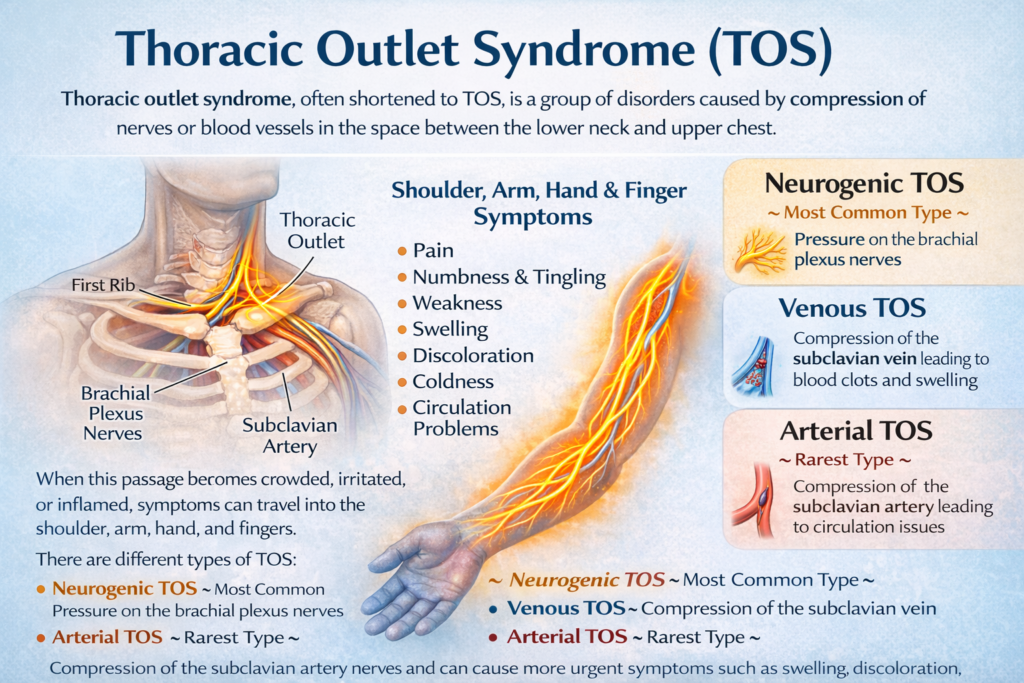
Nerves are like electrical cables. When they are squeezed, irritated, or stretched, their signal can become noisy. That noise may show up as:
Tingling in the arm or hand
Numbness in the fingers
Aching in the neck, shoulder, or upper back
Weakness in the hand
Heaviness with overhead activity
These symptoms are common when nerve structures in the thoracic outlet are compressed. Medical sources note that TOS can cause pain in the shoulder and neck, along with numbness, tingling, or weakness in the arm and fingers.
Common Triggers That Can Make Symptoms Worse
Many people notice symptoms increase with:
poor posture
rounded shoulders
repetitive overhead activity
long hours at a desk
tight chest and neck muscles
carrying heavy bags
old injury or trauma
In other words, the body can become like a crowded intersection at rush hour. Add tight muscles, bad posture, and repetitive use, and suddenly the nerves have no smooth lane to travel through.
Where Ball Acupressure May Help
Ball acupressure works by applying steady, targeted pressure to tense muscles and connective tissue. The goal is not to mash the area aggressively. The goal is to reduce excessive muscle guarding, improve local circulation to soft tissues, and encourage better movement patterns.
For people with TOS-like tension patterns, the useful targets are often not the thoracic outlet itself. Instead, they are the surrounding muscular “traffic makers,” such as the chest, upper back, shoulder blade region, and occasionally the side of the neck when approached very carefully.
Medical guidance for TOS commonly includes conservative care such as posture correction, ergonomic changes, physical therapy, and muscle-focused treatment approaches. Reviews of conservative treatment also suggest symptom improvement is possible with non-surgical management, especially when function and mechanics improve.
The Realistic Benefit
Ball acupressure may help by:
- relaxing tight pectoral and upper back muscles
- improving body awareness and posture
- reducing trigger-point tenderness
- easing secondary muscle tension around the neck and shoulder girdle
- making stretching and corrective exercise feel easier afterward
That last point matters. Ball acupressure often works best as part of a bigger strategy, not as a stand-alone fix.

Areas That May Be Worth Addressing
Pectoral Muscles
Tight chest muscles can pull the shoulders forward and add crowding across the front of the shoulder girdle. Releasing these tissues may support a more open posture.
Upper Trapezius and Levator Scapulae
When these muscles stay tense, the neck and shoulder region can feel like a clenched fist. Gentle pressure can sometimes reduce that guarding.
Rhomboids and Mid-Back Muscles
These muscles help support the shoulder blade. When they are stiff or weak, the whole shoulder mechanism can become less efficient.
A Key Principle
We should avoid thinking, “The tingling is in the hand, so the hand is the problem.” In TOS, symptoms may show up downstream while the real tension pattern lives upstream.
How to Use Ball Acupressure Safely for TOS-Like Symptoms
If we use ball acupressure for thoracic outlet-related discomfort, gentle and precise is the rule. This is not a deep-tissue contest.
- Use a tennis ball or a similar soft ball.
- Start on the upper back or shoulder blade area, not directly on the front of the neck.
- Lean lightly into the wall rather than lying with full body weight.
- Hold on a tender point for 20 to 45 seconds while breathing slowly.
- Move off if symptoms shoot, burn, intensify, or travel down the arm.
- Follow with posture reset, chest opening, and gentle range of motion.
What “Good Pressure” Feels Like
A productive sensation feels like relieving pressure, melting, or a “hurts-so-good” tenderness that fades as you breathe.
What “Bad Pressure” Feels Like
Stop immediately if you trigger:
- stronger numbness
- electric pain into the arm
- throbbing or pulsing discomfort
- dizziness
- hand color changes
- swelling or coldness
Those are not signs to push harder. They are signs to back off and get evaluated.
When Ball Acupressure May Not Be Appropriate
This is the part many people skip, but it matters most. Ball acupressure is not appropriate as self-treatment when symptoms suggest vascular involvement or serious nerve compression.
Red flags include:
- hand or arm swelling
- bluish or pale color changes
- cold hand compared with the other side
- severe weakness
- worsening symptoms at rest
- symptoms after trauma
- persistent numbness that does not improve
- chest pain or shortness of breath
Vascular forms of TOS can affect circulation and may require urgent medical attention. Mayo Clinic and Cleveland Clinic both note that treatment depends on the type of TOS, and vascular cases are a different category from muscle tension alone.
Ball Acupressure Is Most Useful as Part of a Bigger Plan
Let’s be honest: most long-standing arm tingling is not solved by one trick. The best results usually come when we combine techniques.
: Smart Supportive Strategies
Ball acupressure pairs well with:
posture retraining
ergonomic changes at the desk
reducing overhead strain
breathing work
chest opening stretches
scapular strengthening
physical therapy guidance
Rehabilitation sources describe TOS management as a process that often focuses first on conservative care, including manual therapies, stretching, movement correction, and neuromuscular control.
Think of It Like This
If your body is a tent and the ropes are pulling unevenly, ball acupressure may loosen one tight rope. But you still need to straighten the poles and reset the whole structure.
What Results Can We Reasonably Expect?
Some people feel relief right away, especially when muscular tightness is a major driver. They may notice less neck tension, easier shoulder movement, or reduced arm heaviness after a session.
Others feel only partial improvement. That does not mean the method failed. It may mean the condition is more complex, the pressure points are poorly chosen, or the problem involves true nerve or vascular compression that needs medical guidance.
The most realistic expectation is this: ball acupressure may help reduce soft-tissue tension that contributes to symptoms, but it should not be expected to “fix” thoracic outlet syndrome by itself. That balanced view is consistent with mainstream TOS care, which emphasizes tailored treatment based on the underlying cause and type.
Conclusion
Ball acupressure may help some people with thoracic outlet syndrome-related tension, especially when poor posture, tight chest muscles, and overworked shoulder tissues are part of the problem. It can be a simple, low-cost way to calm muscular guarding and support better movement. But we should keep our feet on the ground. TOS is not just “a knot in the shoulder.” It is a condition involving possible nerve or blood vessel compression, and that means careful judgment matters. Used wisely, ball acupressure can be a useful tool in the toolbox. Used carelessly, it can irritate an already crowded space. The smart path is gentle pressure, good technique, and professional evaluation whenever symptoms are severe, persistent, or suspicious.
FAQs
1. Can ball acupressure cure thoracic outlet syndrome?
No. Ball acupressure may help reduce muscular tension that contributes to symptoms, but it is not a cure for thoracic outlet syndrome.
2. Where should we avoid using the ball with TOS symptoms?
Avoid aggressive pressure on the front of the neck, collarbone region, or anywhere that causes shooting symptoms, dizziness, swelling, or color changes.
3. How often can we use ball acupressure for arm tingling?
Many people tolerate short sessions of a few minutes once or twice daily, but the key is symptom response. More pressure is not always better.
4. Can posture really make thoracic outlet symptoms worse?
Yes. Rounded shoulders, forward head posture, and repetitive overhead activity can all increase strain in the neck and shoulder region and may aggravate symptoms.
5. When should we stop self-treatment and see a doctor?
Seek medical care if you have swelling, arm discoloration, coldness, marked weakness, severe pain, symptoms after trauma, or numbness that keeps worsening.